A day in the life, in the Congo rainforest

A further installment from last summer’s research trip to the Congo


Within an hour of sunrise, I was woken by the heat. Outside my tent, Jerome sat on a makeshift bench, with his laptop open in front of him.

“If you want to work with these people, you’re going to have to get up earlier than this,” he said.

It was 7 AM.

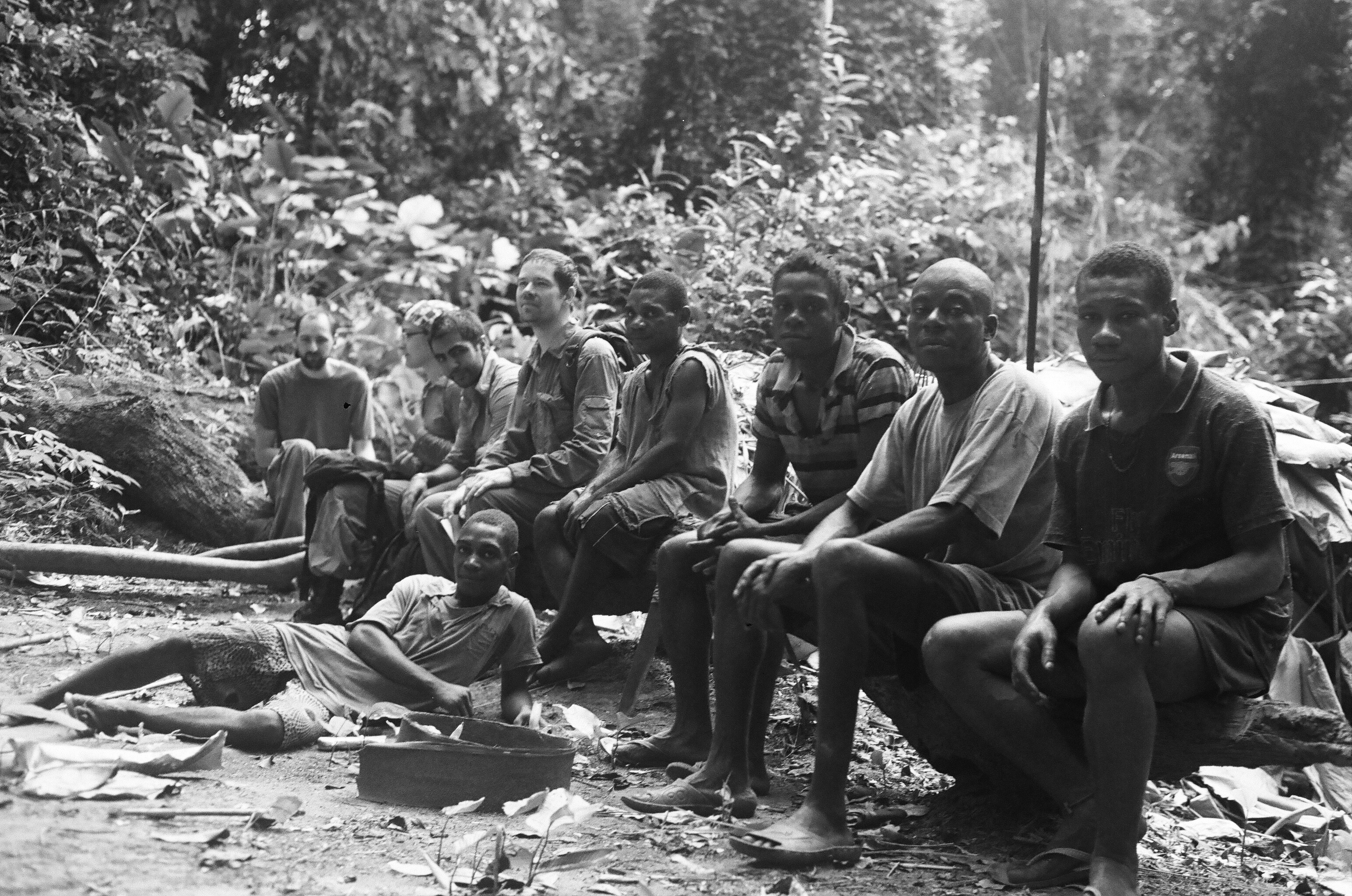
Next to Jerome sat three Mbendjele men. As I set about making coffee, they watched me carefully, occasionally chatting and laughing, and passing around a joint. The men, it turned out, were brothers, and founding members of the three camps in this part of the forest. Over the following weeks, they became well known to us, as during the days we mapped their family trees; and on a few occasions we followed them along forest trails as they went out to check traps.


congo_2013


We’d traveled here to learn about their lives in a part of the world — the Central African rainforest — where, more than anywhere else, hunting and gathering remains a viable way of life. In line with Jerome’s advice, for the rest of the three months of fieldwork, we woke up earlier, and started work soon after first light. By a couple of hours after dawn, many people would head out into the forest to gather food.

Our work — which in addition to interviews, involved weighing and measuring, and taking saliva samples for genetic analysis — amused some people and perplexed others. But for the most part they put up with it all with patience and good humour.

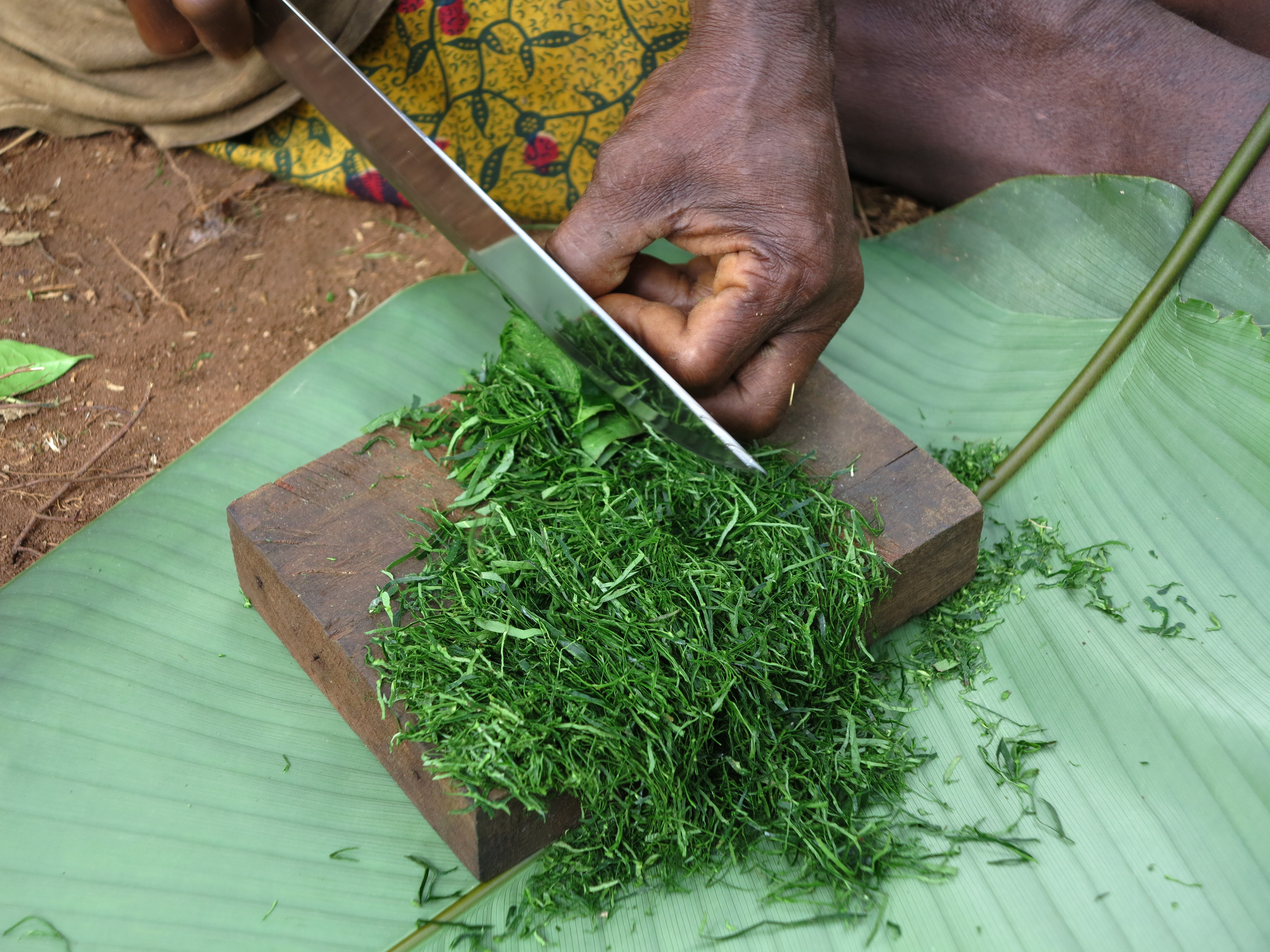
By afternoon, women would begin drifting back into camp from the forest, carrying whatever they’d found in baskets on their backs: koko (leafy greens), miya (wild yams), bambu (a very sticky, sweet fruit); and sometimes palm-fruit or a few small fish.


IMG_3640


As the sun started sinking in the sky, we’d walk down to the river to bathe, and Ndambo, the team’s cook, would prepare our dinner — most often, rice and roast antelope.

After dark a new shift began for the forest community, and sometimes we heard gorillas or elephants calling to each other.

(The gorilla makes a sound (bo-bo-bo-bo!) that inspired their name in BaMbendjele: ebobo).

They’re the owners of the forest,” the locals said.

Other times the insistent cry of a tree hyrax searching for a mate would echo through the trees.

And on certain nights — we never could predict when — we’d hear the deep voices of those men who’d first welcomed us to their camps, joined with those of the women and children in song.


For more information on the Hunter Gatherer Resilience Project, visit the project website: http://www.adapting.org.uk/

Anthropolitan, the UCL Anthropology Department magazine, includes contributions from several other  members of the HG Resilience team in its latest issue.


Posted in anthropology, Congo, food, hunter-gatherers | Leave a comment

The roots of egalitarianism

Are we natural democrats? Or will tyrants always be with us?


IN THE TWENTIETH CENTURY, a handful of anthropologists, living with hunter-gatherers, described the workings of societies without leaders, where food seemed to be equally available to all. [1]

These reports resonated with Rousseau’s visions of primitive equality and Marxist theories about the deep roots of communism. [2]

Could hunter-gatherers be seen as “living fossils,” showing us how we all once lived — and might one day live again?
 

forest ppl_cover2

Cover image from Turnbull’s Forest People


In the past decades a lot of new work has been done that is relevant to these questions.

Nobody now believes that modern hunter-gatherers are typical of our way of life in the Palaeolithic. But there’s broad agreement that they can shed light on ancestral conditions — that they’re the best analogue we have. [3]

While memory of the Conference on Hunting and Gathering Societies is still fresh, I’ll share some current thinking on political organization among hunter-gatherers — particularly the question of how egalitarianism might have evolved.


The egalitarianism papers

In Liverpool there were two presentations on hunter-gatherer egalitarianism — one by Frank Marlowe of Cambridge, and one by me.

Marlowe, using a carefully drawn sample of cultures, showed that lack of social stratification is more common among hunter-gatherers than in societies relying on other types of subsistence (farmers, horticulturalists, or pastoralists).

And among hunter-gatherer populations, those with higher rates of mobility and greater reliance on large game for their diet are less likely to have social stratification.

In other words, while not all hunter-gatherers are egalitarian, those who are, tend often to be mobile and rely on big game.

How typical these features were of our ancestors is a point of contention (to which we’ll return).

In my presentation, I focused on the possible origins of egalitarianism.


Proximate versus ultimate causation

Work on the evolution of egalitarianism, I suggested, might profit from observing a distinction that biologists often make between forces that could select for a behavior and forces that could maintain it once it emerged.

Taking bird migration as an example, the forces that could lead birds in the northern hemisphere to migrate south during winter include genetic disposition and lack of food (ultimate causes), and physiological responses to falling temperature and shorter days (proximate causes). [4]

Only the “ultimate” forces, it’s generally agreed, could cause the behavior to evolve by natural selection.


In the case of egalitarianism, ultimate mechanisms would cause differential survival in hierarchical versus non-hierarchical groups; and proximate mechanisms would include various ways of keeping the playing field level — for example by knocking down aggrandizers.

Some mechanisms that might account for the evolution of egalitarianism are kin selection (favouring your kin, which could promote egalitarianism if relatedness within the group were high), reciprocity (trading of favours), assortment (associating only with others who had proven themselves in the past), and group selection (treating group members as equals, and competing together against other groups).

Some of these ideas can be eliminated quickly. Kin selection, for example, doesn’t square with what we know about hunter-gatherer band composition. (Band membership tends to be diverse and fluid, and kin biases would be hard to maintain. [5]) But others are more difficult to evaluate.


Virtual worlds

Computer simulation seems to be a promising way of investigating how ideas such as these stand up in relation to one another.

Dispensing with all but the most basic features of social life, agent-based models make it possible to investigate the emergence of complex social phenomena from relatively simple rules of social interaction. [6]

A model created by Gavrilets, for example, begins with “bullies” attempting to steal food from others (a common enough occurrence in primate societies). The model demonstrates how, when other group members intervene to defend the weak from bullying, a social norm of fairness can emerge, and this in turn can lead to a stable mode of egalitarianism.


The challenge remains to integrate models with real-world data — to let the virtual and actual worlds speak to each other.

Not long ago, you had to have specialized training to develop and run computer simulations. But within the last decade, off-the-shelf simulation packages have proliferated, and it’s now possible for anyone with even basic computer literacy to experiment with agent-based modeling, for example with NetLogo.

 

Netlogo-altruists_win

A screenshot from a simulation of the evolution of altruistic tendencies in a population, in the free NetLogo software package


Provocation

The presentations generated a lively discussion.

Chris Knight took issue with our lack of attention to gender relations.

How could we attempt to understand egalitarianism without taking relations between men and women into account? he asked.

And Ian Watts asked on what grounds I was calling leveling mechanisms a “proximate” force in the evolution of egalitarianism.

Couldn’t they be a primary force in pushing groups towards egalitarian modes?

These questions stimulated me to think about this problem in a new way.


Complex causation

Reading further on the ultimate/proximate distinction, I realized that something of a revolution is underway in how evolutionary biologists are thinking about causation.

Back in the 1970s, Stephen Jay Gould devoted a book to the history of inquiry into the relationship between evolution and life-course development, showing how the topic has been an enduring source of controversy. [7]

The most recent cycle of work in this area has led to a rethinking of the ultimate / proximate distinction. [8]

One of the frame-shifts that this has brought about relates to the idea of the nuclear family versus the extended group as the locus of child rearing.

Hunter-gatherers rely heavily on other members of their groups to share care of offspring, and their kinship and marriage systems seem designed to maximize the availability of helpers. [9]

Networks of support may be spread wider still by cultivating friendships (think of godparents) — what are sometimes called “social kin.” [10]

Sarah B. Hrdy’s hypothesis is that

“Novel rearing conditions among a line of early hominins meant that youngsters grew up depending on a wider range of caretakers … and this dependence produced selection pressures that favored individuals who were better at decoding the mental states of others, and figuring out who would help and who would hurt.” [11]


mothers & others_cover


This ability to read others’ minds and intentions — part of what Hrdy calls “emotional modernity” — would facilitate shared child care; and once care was widely enough distributed, the reproductive success of individuals could begin to be favoured by egalitarian arrangements.


Gender relations

This scenario opens the door to gender relations as a prime mover in the evolution of egalitarianism, as it implies a shift from a situation where mothers bore sole responsibility for child care, to one where others, including men, shared it.

At the same time, the overturning of the proximate/ultimate distinction also makes other hypotheses seem more plausible, for example the idea that being generous with food, and refraining from self-aggrandizement, could be a means of indicating an individual’s fitness (a “costly signal”). [12]


Many roads

As the number of competing hypotheses grows, one may start to wonder whether there’s any hope of resolving the question of how egalitarianism might have evolved.

At least three lessons, however, emerge from all this for me:


First, there is no reason to suppose that egalitarianism should have evolved by the same mechanism everywhere.

Like birds and bats, which made similar-looking wings out of very different starting materials, different human groups may have arrived at egalitarian arrangements by different routes.

Working out which mechanisms were most important for different groups, at different times, requires attention to some of the key variables that scholars have identified, for example the importance of big game hunting and degrees of mobility.


Second, we need not assume that hunter-gatherers in the distant past were always egalitarian.

It could be, instead, that we have an ability to shift into egalitarian mode under conditions that favour it — we might be facultative or “fair weather” egalitarians. [13]


Third, cultural evolution opens up a wide range of possibilities for the emergence of egalitarianism.

While birds migrating south for the winter may be locked into their behavior patterns by genetic control, human culture permits great flexibility.

Acknowledging that “our species is free neither of itself nor its environment,” [14] the overlay of cultural processes in humans nonetheless creates the possibility of conscious, directional change in political organization.


There’s reason, in other words, for hope that we’re predestined neither for communism nor for tyranny.


References

[1] e.g. the Mbuti of the Congo and the Hadza of Tanzania. Mbuti: Turnbull, Colin. 1961. The Forest People. Simon and Schuster;  Hadza: Woodburn, James. 1982. ‘Egalitarian Societies’. Man 17 (3) (September 1): 431–451. doi:10.2307/2801707.

[2] Speth puts it well: “Modern foragers, whether they are isolated and autonomous or not, must nevertheless confront and cope with demographic, social, dietary, and other problems that are common to any human society, past or present, that relies for part or all of its sustenance on wild plant and animal foods.” (J.D. Speth, 1991. In Foragers in Context: Long-term, Regional, and Historical Perspectives in Hunter-gatherer Studies (Vol. 10). Ann Arbor: Department of Anthropology, University of Michigan, p. viii)

[3] Engels, Friedrich. 1884. The Origin of the Family, Private Property, and the State. London: Penguin Classics; Rousseau, Jean-Jacques. 1755. A Discourse on Inequality. London: Penguin Classics.

[4] Mayr, Ernst. 1961. ‘Cause and Effect in Biology’. Science 134 (3489) (October 11): 1501–1506. doi:10.1126/science.134.3489.1501.

[5] Hill, Kim R., Robert S. Walker, Miran Božičević, James Eder, Thomas Headland, Barry Hewlett, A. Magdalena Hurtado, Frank Marlowe, Polly Wiessner, and Brian Wood. 2011. ‘Co-Residence Patterns in Hunter-Gatherer Societies Show Unique Human Social Structure’. Science 331 (6022) (November 3): 1286–1289. doi:10.1126/science.1199071.

[6] Gavrilets, Sergey. 2012. ‘On the Evolutionary Origins of the Egalitarian Syndrome’. Proceedings of the National Academy of Sciences (August 13). doi:10.1073/pnas.1201718109. http://www.pnas.org/content/early/2012/08/08/1201718109.

[7] Gould, Stephen Jay. 1977. Ontogeny and Phylogeny. Cambridge: Harvard University Press.

[8] Laland, Kevin N., Kim Sterelny, John Odling-Smee, William Hoppitt, and Tobias Uller. 2011. ‘Cause and Effect in Biology Revisited: Is Mayr’s Proximate-Ultimate Dichotomy Still Useful?’ Science 334 (6062) (December 16): 1512–1516. doi:10.1126/science.1210879.

[9] Hrdy, Sarah Blaffer. 2009. Mothers and Others: The Evolutionary Origins of Mutual Understanding. Cambridge: Harvard University Press.

[10] Wiessner, Polly. 1986. ‘!Kung San Networks in a Generational Perspective’. In The Past and Future of!Kung Ethnography, pp. 103-136, edited by Megan Biesele, R. Gordon, and Richard B Lee. Hamburg: Helmut Buske Verlag; Holland, Maximilian. 2004. ‘Social Bonding and Nurture Kinship’. PhD thesis, London: London School of Economics; Hruschka, Daniel J. 2010. Friendship: Development, Ecology, and Evolution of a Relationship. University of California Press.

[11] Hrdy, 2009. Mothers and Others, p. 66

[12] Power, Camilla. 2009. ‘Sexual selection models for the emergence of symbolic communication’. In The Cradle of Language, edited by Rudolf Botha and Chris Knight, 253–277. Oxford: Oxford University Press; Zahavi, Amots, and Avishag Zahavi. 1999. The Handicap Principle. New York: Oxford University Press.

[13] This idea of oscillation between egalitarian and hierarchical social structures was suggested by James Woodburn.

[14] Lancaster, Jane B. 1975. Primate behavior and the emergence of human culture. Fort Worth: Holt, Rinehart, and Winston, p. 1

Posted in evolution, politics | Tagged , , , , , , , | 4 Comments

Hunter-gatherer conference: day 1


Today was the first day of the international Conference on Hunting and Gathering Societies (CHaGS).


The 10th meeting of its kind since 1966, it’s brought together approximately 200 delegates — scholars from all four continents, and from the disciplines of anthropology, history, archaeology, and genetics — in Liverpool.


chags-hands


The only thing more diverse than the delegates, perhaps, are the people who are the subject of the conference: the hunters and gatherers who once lived all over the world, and who live still in parts of Africa, Asia, South America, Australia, and the Arctic.


Why does this stuff matter?


This afternoon’s session on Violence serves as an illustration of why everyone should be interested in hunter-gatherers.


Richard B. Lee, an ethnographer of the Kalahari (and a convener of the first international hunter-gatherer conference in 1966), took on the topic “Hunter-gatherers on the bestseller list.”


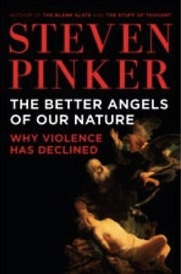
His presentation focused on a popular 2011 book by Steven Pinker, The Better Angels of our Nature: Why Violence has Declined.


chags-betterangels


Pinker — and others whom Lee refers to as “the Bellicose School” — cast hunter-gatherer societies (and by extension all of humanity before the origins of agriculture, approximately 10,000 years ago) as being far more violent than modern, industrialized societies. [1]


Having established a contrast between hunter-gatherer violence and modern pacifism, Pinker argues that Western institutions may be responsible for the decline of violence.


What’s at stake here, Lee pointed out, is nothing less than our understanding of human nature, and of grand patterns in history.


This is part of a debate that’s often framed in terms of an opposition between a Hobbesian “war of all against all” and a Rousseauian state of primitive harmony.


But Lee’s own work in the 1980s busted both myths at once: The Ju’/hoansi (!Kung San) communities that he studied, he discovered, had homicide rates roughly equal to 20th century American cities.


But no war.


That’s the kicker.


Without warfare between groups — something hunter-gatherers seldom engage in, partly because of the fluid and decentralized nature of their communities — rates of violent death are almost certainly far lower in hunting and gathering societies than in industrialized ones, with their recurrent military conflagrations.


Lee didn’t seek to replace Pinker’s grand narrative with another one, but the evidence would seem to fit a trend of increasing violence through history at least as well as a trend of increasing peace.


An important difference, however, may be that violence in our culture has been in large part hidden, and professionalized: contracted out to soldiers or mercenaries, and exported to other countries.


This is just one example of how attention to the people still living by hunting and gathering — and the evidence left behind by hunter-gatherers of the past — can help us understand ourselves.


chags-studyarchaeology


Notes


[1] Pinker’s interpretation, Lee argued, is largely due to errors of categorization: lumping other “pre-modern” societies, such as the manifestly violent horticultural groups of highland New Guinea, and the Yanomamo of the Amazon, together in the hunter-gatherer category.

Others whom Lee considers as members of the “Bellicose School” are Richard Wrangham and Dale Peterson (authors of the 1996 book, Demonic Males).


For the data that suggest hunter-gatherers experienced less violence, Lee referred to Douglas P. Fry, ed. (2013) War, peace, and human nature: The convergence of evolutionary and cultural views. New York: Oxford University Press (esp. chapter 10, by Haas & Piscitelli, on violence in the archaeological record).

Posted in anthropology, hunter-gatherers | Tagged , , , , , , , | 4 Comments

Four ways to change the world, from university

Last week a conference at University College London made me reconsider what universities are, and what they might be.

These thoughts seem so vital right now that I’m interrupting the narrative of my trip to Congo to share them.

The conference brought some one-hundred UCL researchers together with members of the university’s teaching faculty and administration, to address “the career and professional development of research staff.”

But for me a larger theme ran through it all: the place of the university in the world.

Fulfilling the university’s promise

Established by Jeremy Bentham in 1826, UCL was the first university in Britain to admit women, and the first to devote departments to such practical subjects as engineering and economics. The idea of applied research was then new.

It’s a sentiment that lives on in the slogan of UCL’s Department of Engineering: “Change the world.”

changetheworld

The question that bugs me is How?

Specifically, what kind of world do we desire? How do we go about the task of bringing this world into alignment with it? And what can academics contribute to the task?

The conference threw up several answers to these questions for me. But they weren’t always consistent with each other.

1. Observe, catalogue, collaborate

Anthony Finkelstein, the Dean of Engineering at UCL, suggested a 3-step approach to addressing the challenges the world is facing:

1.    Take time out to observe the world.

2.    Catalogue where your work engages with global problems.

3.    Build groups of friends and collaborators around global challenges.

A self-described “born again” social media enthusiast, Finkelstein (who blogs here) also pointed to the potential of the internet to democratize knowledge, breaking down barriers between academia and the public.

Perhaps by combining the skills of experts with the enthusiasm of a connected public, we could bring about really revolutionary change in combating poverty, hunger, and ill-health.

2. Practice scholarship with integrity

David Price, the Vice-Provost for Research, pointed out a potential flaw in this formula, and made the case for a quieter sort of revolution.

In 1998, he recounted, a London medical researcher published a bogus correlation between children receiving the MMR (measles, mumps, and rubella) vaccine and the incidence of autism. Widely reported in the media, this led to a decline in child vaccinations, and, eventually — during last winter’s measles epidemic — to child deaths. [1]

The story demonstrates what great harm unscrupulous researchers can inflict, and how the media can interfere in communication between scholars and public.

The greatest contribution researchers can make to society, Price argued, is through increasing the integrity and credibility of science.

It’s due to a lack of trust in science that a question mark hangs over the issue of human-induced climate change in the minds of politicians and the public.

All of us in academia contribute to or detract from the credibility of the scientific community — even through the most mundane details of our professional work.

Don’t exaggerate the significance of your findings, Price exhorted us.

Don’t extrapolate beyond the range of your data.

And don’t abuse the peer review system — for example by axe-grinding behind the cloak of anonymity.

A culture of integrity in scholarship, he implied, could work wonders for society — rather as the personal decency of James Stewart’s character in the film It’s a Wonderful Life ramified to the benefit of his community.

3. Fix people problems

Most of the world’s problems aren’t the result of widgets or gadgets failing, but the result of people failing, said Maurice Biriotti, another presenter.

After a “three o’clock in the morning moment” Biriotti resigned from his lecturing job in Literature to establish a consulting firm.

SHM Productions provide their clients with information on what the public thinks about given issues; help effect change when a company is encountering opposition among its rank and file; and repair corporate disputes — for example when two multinationals sign a merger agreement and then have a falling-out.

The firm was held up as an example at the conference, and it’s surely an impressive illustration of how academics can apply their skills outside of the university.

But it also points to the danger of scholars allowing corporations – and the pursuit of profits – to determine the research agenda. [2]

In the process, academics may contribute to changing the world, all right, but it’s liable to be change of a regressive sort!

Or, at least, a defence of the business as usual in the industrialized countries that spells disaster for the world: a continuation of global inequities and ecological decline.


4. An eclectic approach

It seems to me that what’s needed is a combination of the approaches that the people at the conference talked about:

Observe, catalogue, collaborate, and communicate, yes.

Practice scholarship with integrity.

And engage with business — which must be part of the solution as well as part of the problem — but, as much as possible, on your own terms. [3]

What’s crucial, if the university is to fulfil its promise to change the world for the better, is that it maintains independence from the interests of commerce just as much as it does from those of the church and party politics.

It must be a place where the question, What sort of world do we desire? can be entertained freely.

For most of human history, philosophical questions like this one have been framed in religious terms. The independent social space that reformers like Bentham carved out for the university is precious.

ucl_mainbldg

UCL’s main building

And yet forging a new and better world will likely require a kind of inspiration that, until recently, has been the preserve of religion.

As Karen Armstrong has warned us,

Unless there is some kind of spiritual revolution that can keep abreast of our technological genius, it is unlikely that we will save our planet. A purely rational education will not suffice.

We have found out to our cost that a great university can exist in the same vicinity as a concentration camp. [4]

References

[1] On the MMR-autism scandal:

http://en.wikipedia.org/wiki/MMR_vaccine_controversy
http://www.guardian.co.uk/society/2013/apr/25/mmr-scare-analysis

Before the measles outbreak, the Lancet had retracted the paper, and exposed the article’s findings as fraudulent. But the idea of the danger posed by the vaccine remained out there, and the damage was done.
[2] George Monbiot recently criticized British academia for accepting money from corporations whose interests are intrinsically oppositional to the values that universities should be standing up for.

One such contradiction at UCL is the sponsorship of its Institute for Sustainable Resources by BHP Billiton, one of the world’s largest coal-miners.

[3] Paul Hawken makes a strong case for the importance of business in addressing our ecological predicament in The Ecology of Commerce (1993, Harper-Collins)

[4] Karen Armstrong (2006). The Great Transformation: The world in the time of Buddha, Socrates, Confucius, and Jeremiah. New York: Random House (p. xi).

Posted in climate, education | Tagged , , , , , , , | Leave a comment

Into the forest

ON THE ROAD out of Pokola, I feel excited. It’s been two weeks since we got to Congo, and now at last we’re entering the forest.

At one point not far out of town, trees form a green tunnel, bending over the road.

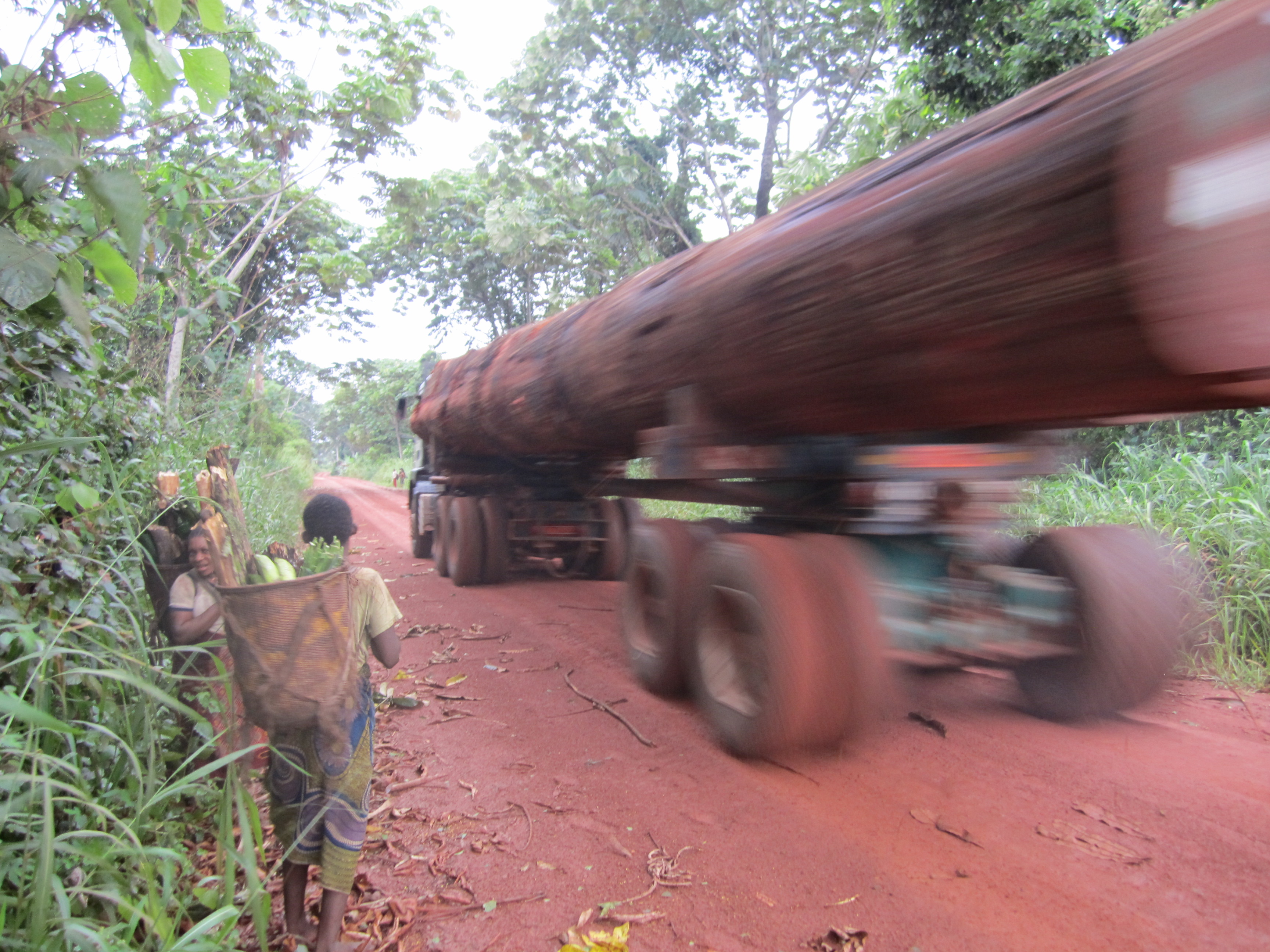
We pass huge trucks speeding in the opposite direction loaded with gigantic logs: tree trunks, bigger than I’ve ever seen, being hauled out of the forest.


cib truck

A juggernaut flies by


The road, which was merely a footpath until CIB exploited the forest around here in the late ’90s, sees at least one large truck and several taxis each day, as well as motorcycle traffic — mostly Bantu traders who travel between Pokola and the villages around Minganga,  buying up forest products (bushmeat, and also the mongongo leaves used for wrapping street food) and selling produce from town (tobacco and alcohol, rifle cartridges and shotgun shells, and food staples such as manioc and taro).


Striking camp

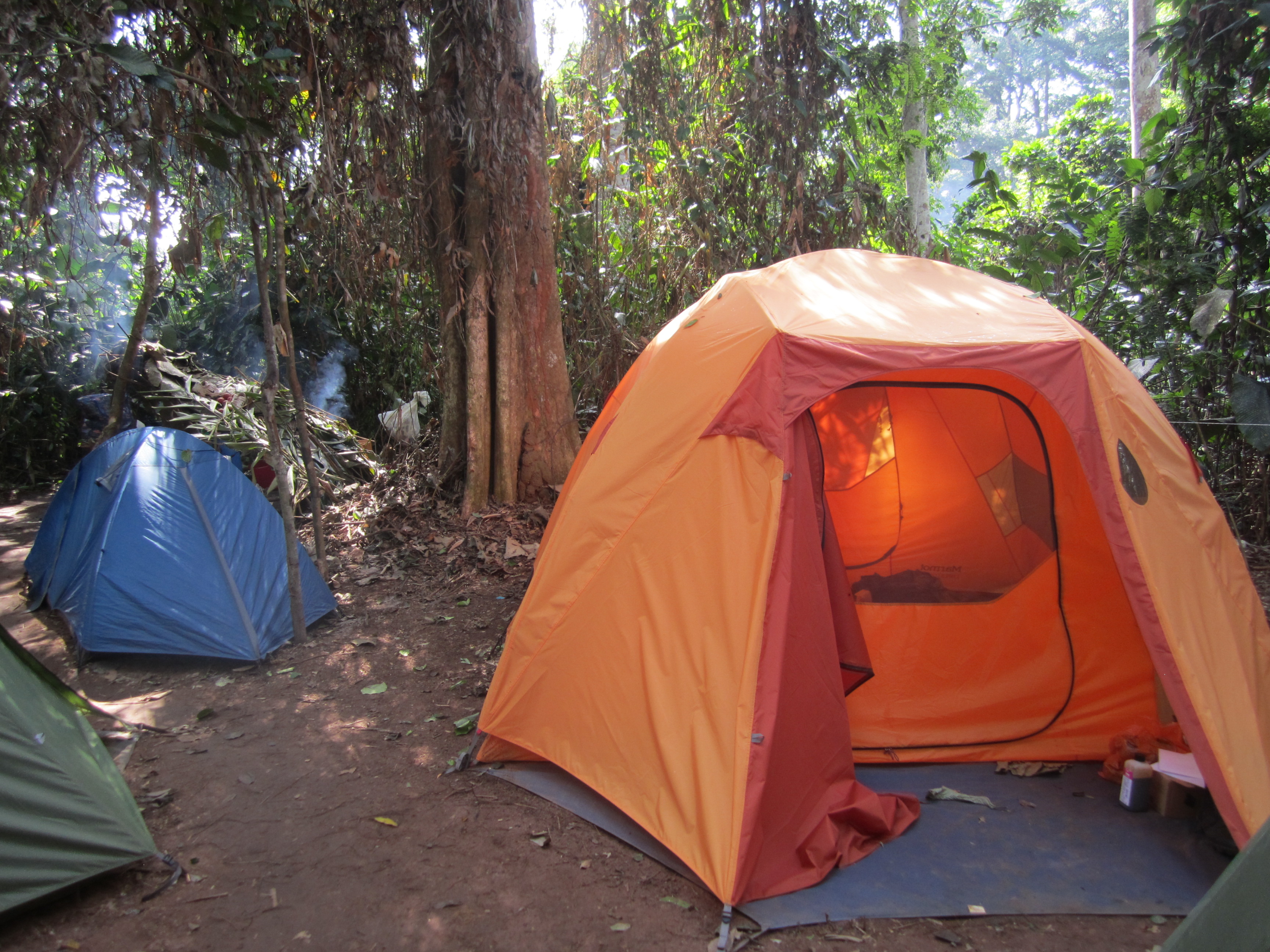
The place where we settle is a roadside camp.


local camp

The local camp

our camp

and ours


The people who live here, previously known to outsiders as Pygmies, are now commonly referred to as autochtones, a term (derived from Greek words meaning “[from] the ground itself”) that’s equivalent to the word ‘indigenous’ in English.

They describe themselves as Baaka (singular Moaka) — a word that denotes a regional and linguistic affiliation broad enough to span borders in central Africa, but indicating a subset of the people formerly called pygmies. They also use terms that are more restrictive still, such as Mbendjele — a dialect group within the Baaka.

There’s no other term, except perhaps ‘forest foragers’ that has an equivalent referent to ‘Pygmy’. [1]

This is unfortunate, because Pygmy also has negative connotations, reflecting a long history of discrimination.


Introductions

After dinner, at Jerome’s suggestion, we prepare ourselves for a ceremony to introduce ourselves to the community and inaugurate our stay.

We gather outside Jerome’s tent, and once he’s up, he leads us over to the main camp.

Looking up at the canopy of trees and the darkening sky, I see a crescent moon; and a flash in the sky.
A shooting star?

As we walk along the road towards the camp, fireflies light up the space around us.

It was one of them, I realize, that I’d taken for a shooting star.

Jerome leads us into the clearing at the centre of the camp, and some women and children, sitting outside their houses, offer us stools to sit on.

After a few minutes have passed and nobody else has appeared, Jerome summons the community.

Oka! Oka!” he shouts. (Listen, listen!)

Soon the men of the camp, who had been eating indoors, come out and sit on mats on the ground.

Jerome addresses the camp in the Mbendjele language, and attempts to explain the idea of a university, and the different areas of research that people might specialize in.

“In our country there are people who study the moon and the stars; there are others who study the earth,” he says.

The team he has brought here is doing research on people. They would like to stay with you here, he says. And they will explain to you what they will be doing.

Then he turns things over to me.

I speak in French, pausing after each sentence for Independant to translate.

I try to distinguish us from missionaries on the one hand and conservationists on the other — two categories of foreigners that I assume they are familiar with.

“Thank you for welcoming us into your community,” I say. “We respect your culture, your knowledge, your traditions. We have come here to learn from you.

“We are especially interested in the history of your families–”

“He’s struggling with that,” Jerome says to me aside, as Independant tries to translate this phrase, “because there’s no word for history in their language.”

I make a mental note, and go on.

“We’re also interested in understanding how people’s bodies change as they grow from children, to adults who hunt and gather, to elders.

“We’ll start by doing a quick tour around the community,” I say. “We’ll ask your names and take photographs of people in each house.”

To illustrate, I jog around the roughly circular space in the centre of the camp, and mime taking notes on a few of the people who are seated on the ground as I go.

“That will take just one day.

“After that, we’ll do a second, slower tour.”

I walk around the circle again now, more slowly, and squat next to one group of women and children.

“At that time we’ll ask about your families — Who are your parents, who are your grandparents? And we’ll measure your height and weight….”


Slide1

A poster illustrating some of our research goals


“If you have questions about any of these things, we’ll be happy to answer,” I say.


There are no questions right away, but instead a chorus of “Bien.”


Then an old man of the community responds.

We are welcome to stay with them, he says.

He goes on to explain something of the local context:

There aren’t many people in the forest now. The ecoguards [armed rangers who are officially responsible for protecting endangered species] have been harrassing people.

As a result, Baaka have come together in camps along on the road, and have gathered around the Bantu villages of the Yesua and Kabunga, near Minganga.

“Now we would like to sing and dance,” he says. “Would you?”


I’m a bit surprised by this, and look to the others for guidance.

At first, receiving signals I interpret as negative, I say no — tomorrow would be better.

But very quickly the women and girls begin to sing, and once the song has begun, it’s difficult to tear ourselves away.

Soon the whole community has joined in the music-making, clapping in complex rhythms.

After some 20 or 30 minutes, dancers costumed in leaves — forest spirits — emerge out of the shadows. And then retreat, and reappear.

Their faces are hidden, but from their movements they seem to be male. Some make bird-like sounds, while another hoots low and insistently like some kind of wild ape.

They’re boys’ spirits, I overhear Jerome saying later; mobele, Esimba calls them.


children forest spirit

A forest spirit and his friends


In the following days we get used to hearing singing and clapping; seeing men and women dance; and to the visitation of spirits.

But somehow, no matter how often we hear people break into song — in this society without fixed schedules or formal leaders — it always seems like a surprise.


References

[1] B. Hewlett (1996). Cultural diversity among African pygmies. In S. Kent, ed. Cultural diversity among twentieth-century foragers: An African perspective. Cambridge: Cambridge University Press, pp. 215-333.


Posted in Congo | Tagged , , , , , | 8 Comments

Arriving in Congo

FROM THE RIVERSIDE, you can see both of the Congos at once.

Across the Pool Malebo, the widest point on the river, Brazzaville and Kinshasa — the capitals of the Republic of Congo and the Democratic Republic of Congo (the former Zaire) — face one another.

Together they are home to more than 10 million people, and constitute the largest conurbation on the continent after Cairo.

But — as a contributor to the Wikipedia entry on Brazzaville comments — there is, due to “political and infrastructure challenges,” little coordination between the lives of the two cities.

When I asked a local whether he’d ever visited Kinshasa, he told me no.

“I got a visa,” he said.

But then he never got around to taking the ferry.


bville

Avenue de la Paix, Brazzaville


When the two countries are compared, Congo-Brazzaville comes out quite favourably.

Despite a civil war from 1994 to 1997, the country is more politically stable and without such active or powerful opposition groups as the DRC.

Stability is of course a mixed blessing — here, it means power has remained in the hands of the same president for more than 25 years.

Surely he has an easier job than his counterpart across the river, who has almost 20 times as many people to rule (and people speaking more than a hundred languages, compared to about a dozen in the Republic of Congo).


Vive la cooperation

The week before we arrived in Brazzaville, the Chinese president Xi Jinping had visited the city. Signs of the visit were clear: On the ride from the airport to the hotel, we passed posters proclaiming “Vive la cooperation Sino-Congolais!”

“You see Chinese in every town,” said Matthias, a postdoc from UCL who had just come by bus from the north of the country.  There had been many Chinese on our flight from Addis Ababa too.

It’s significant that Brazzaville was Xi’s first stop after Moscow after his election.


Traveling north

The landscape outside of Brazzaville is rolling grassland. Flying over it, you see clumps of forest hugging river valleys and bottomlands.

As we continued north, we crossed larger rivers clogged with thick bands of forest. After that, cloud cover hid the ground from us.

When it cleared, there was nothing but forest below, as far as you could see: a green carpet traced with worm-trail river-streams.

congo forest


Then, as we began the descent towards the town of Ouesso, logging roads became visible, scored into the forest in a grid pattern, looking as if they had been marked into the earth with a fingernail, revealing orange-red dirt beneath.

“This country is empty!” said an Indian engineer on the plane.

Contracted by CIB, a logging company that operates in the region where we were headed, he was there to help build a power plant that would transform sawdust and wood chips — waste produced by the sawmills — into electricity.


Concessionaires

Companies like CIB (Congolaise Industrielle des Bois) are the  inheritors and beneficiaries of the concession system established in colonial days, whereby vast portions of the country were parcelled off for commercial exploitation. Central to the economy, the companies fill in for the state in parts of the country where infrastructure is thin on the ground.

CIB is considered by many to be a model company.

A subsidiary of OLAM (the world’s largest producer of palm oil, according to Tomo Nishihara of the Wildlife Conservation Society), the company’s policies were initially shaped by an idealistic management who, through a long campaign of mapping and planning, set out to exploit the forest’s timber sustainably by extracting trees no faster than the ecosystem could replace them.

They also provide free medical care for indigenous people at the company hospital, and free schooling.


A planned community

Pokola, CIB’s local headquarters, is for us just a jumping-off point for the forest, but it would merit study in its own right. The company employs more than two thousand people here, housed in buildings the size and construction of which corresponds to their position or rank — some of them spacious and built of solid brick, with verandahs and tiled floors; others simple “shotgun” shacks built of cheap wood, with shutters instead of windows for ventilation.

It’s an artificial community of sorts, a peculiar example of the planned town — a topic that brings to mind Hippodamus of Miletos, and Plato’s Republic.


pokola

Company houses in Pokola


It seems all the stranger because the town is sited on the edge of what guidebooks call one of the world’s last areas of wilderness, and on the banks of one of the grandest tributaries of the Congo, the Sangha River.


sangha

Posted in Congo | Tagged , , , | 3 Comments

Fieldwork in Congo

Last week I got back from two months in the Congo.

The trip was in aid of the Hunter-Gatherer Resilience project at University College London, which I’m working on as a post-doc.

Under the guidance of Andrea Migliano (the PI) and Jerome Lewis (a longtime researcher in central Africa), I traveled to the rainforest zone in the north of the country which is home to a large population of hunter-gatherers.


Congo-CIA map

Republic of Congo, aka Congo-Brazzaville.

The area where we worked is between Ouesso and Impfondo, in the north.


Our brief was to estimate rates of birth and death and physical growth in communities living by hunting and gathering.

We also set out to investigate the genetic relatedness of these people to other groups.

In practice, this meant measuring heights and weights, collecting saliva, and doing lots of genealogical interviews.


The UCL research team comprised 3 PhD students in anthropology, one geneticist, and myself.

Jerome was with us for the first days in the field, and 4 locals assisted with camping, cooking, and translation.


Congo-team pic

Left to right, standing: James Thompson, Pascale Gerbault, Jerome Lewis, Esimba, Jed Stevenson
Left to right, seated: Independant Ghislain, Nik Chaudhary, Deniz Salali, Mekouno Paul, Ndambo.


While I was in the forest I had very limited internet access. But I took a lot of old-fashioned field notes.

As I type things up over the coming weeks I’ll be posting some of them here.


congo-diary pic

Posted in Congo | Tagged | Leave a comment

Why we’re blind to climate change

For most people in the developed world both the causes and the effects of climate change are essentially invisible.

Hunkered in a mountain cabin in the 1960s, listening to the rain drumming on the roof, Thomas Merton reflected on the dislocation of city-dwellers from the weather, and from the natural world.

Back in the city, he imagined, “the obsessed citizens plunge through the rain bearing the load of their obsessions, slightly more vulnerable than before, but still only barely aware of external realities.” [1]

At the time when Merton was writing, climate change wasn’t well known. But his lamentation about the disconnection between urban people and “external realities” carries a message that’s still vitally relevant.

As I see it, his point is this: When we perceive the natural world just as a backdrop to the real action of our lives (getting an education, finding a job, raising a family) we are quite oblivious to its patterns.

And as long as we segregate these things in our heads — thinking of the environment as a sideshow, rather than the source of our very existence — no amount of goading or guilt-tripping will motivate us to mitigate climate change.


Collective blind spots

CO2 (like its cousin, carbon monoxide) is an invisible, tasteless, odorless gas. Even when we have on board a fairly detailed working model of the greenhouse effect, it’s hard to think of CO2 as a pollutant, and it’s easy to think of the whole thing as simply an abstraction.

Part of this is a consequence of lifestyle. Our daily contributions to carbon emissions are largely invisible to us. We can turn on the light or turn up our central heating without seeing fuel being burned. Technology neatly masks our consumption.

The mobility of the global elite is another factor that leads to ignorance. When you grow up in one place, go to college in another, and take jobs in three or four different cities in the course of a career, you’re unlikely to notice the effects of climate change.

That’s because the effects are clearest in terms of trends on the local level: creeping changes in the timing of spring or, in monsoon systems, the arrival of the rains; gradually drier summers, and winters that are less cold than they used to be.

People in other parts of the world see this more clearly.

A view from Ethiopia

For peasants in Ethiopia, consumption is not invisible. To cook dinner or heat the house, they have to gather wood, or cut down another tree. And it’s plain to see that the forests are getting smaller.

They’re also much better attuned to the ecological tempo and character of the places where they live than we are — they depend greatly on the predictability of the seasons and of rainfall to grow their crops.  When the rains come late, it can spell disaster.

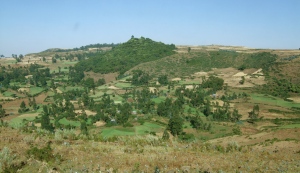
A patchwork of fields in Amhara region, Ethiopia

A patchwork of fields in Amhara region, Ethiopia

The contrast between the keen awareness of these issues among Ethiopian peasants and the blindness to them among Westerners is ironic.

For one thing, the impact that these people have on the biosphere is miniscule compared to ours. [2]

Second, despite the tinyness of their contribution to global warming, they’re in line to suffer sooner and harder than we are.

Third, we’ve had the privilege of extended education; we’ve got access to a dazzling array of information through libraries and the internet.

How come we’re not better informed?

The manufacturing of climate silence

The information we are exposed to is actually part of the problem.

Dependent on mass media for much of our knowledge of climate change, we’re liable to be duped into thinking that the basic facts on the issue are unsettled.

As is laid out in detail in the book, Merchants of Doubt, big business has a long and shameful record of using the media to spread doubt and confusion about environmental health risks. [3]

These efforts have been remarkably successful. It’s largely on their account that public figures can still say, without being laughed at, that scientists are still debating whether climate change is real. [4]

Advertizing meanwhile magnifies the token gestures of big polluters as evidence that they care for the planet.

All of which warps our perceptions. We’re led either into perplexity — thinking that things are still up in the air — or to a false sense of security — feeling that the problem will get fixed through gradual and deliberate change by people more powerful than ourselves.

Smoke in our eyes

Recognizing why we’re blind may be a first step towards improving our vision.

 How, for instance, might we change the technology we interact with every day to remind ourselves of the fact of our consumption, or attune ourselves to the ecological changes happening around us?

Almost a new discipline is required here — at the interface of anthropology, engineering, and product design — concerned with how the design of the things we use every day influences our activity and consumption. [5]

 The crazy, inspired design of a Danish power station indicates what sorts of approaches we could take, to force the connections between power use and carbon emissions into our consciousness.

The power plant will stand in the center of Copenhagen, the tallest structure for miles around. Burning the city’s trash, it will give off smoke not in a continuous stream but in smoke rings — each of them containing precisely 200 kg of CO2! [6]

How will that affect Copenhageners’ energy use?

For me, even the sight of steam coming out of a vent outside my house (visible from our kitchen) makes me think twice about turning the heat on.

Back to nature

Then there’s the challenge of reconnecting with the rhythms of nature.

Short of adopting the lifestyle of an Ethiopian peasant, how do we go about that?

One path is to try to use technology to get to know the places around us better. The EveryAware project, for instance, is developing tools for monitoring air pollution using smartphones. [7]

But there may be no substitute for getting outdoors.

Hunkering down and meditating like Thomas Merton on the exuberant meaninglessness of the rain.

And working to escape the myth we’ve created, before it smothers us.

References

[1] Thomas Merton, “Rain and the rhinoceros.”  Merton, T. (1966). Raids on the Unspeakable. New York: New Directions. http://www.amazon.com/Raids-Unspeakable-Thomas-Merton/dp/0811201015

[2] “If we in North America want to compare [our impact on the environment] to China or India, you’ve got to multiply our population by at least 20, to get our equivalent impact…. If you want to compare us to Bangladesh or Somalia, you’ve got to multiply by at least 60.” — David Suzuki, 2010, summarizing one of the messages of his book, The legacy: An elder’s vision for our sustainable future. (Vancouver: Greystone). Rural Ethiopians’ footprints would be equivalent to Bangladeshis or Somalis.
http://www.loe.org/shows/segments.html?programID=10-P13-00051&segmentID=6

Check your ecological footprint!
http://www.bestfootforward.com/resources/ecological-footprint/
http://www.footprintnetwork.org/en/index.php/GFN/page/calculators/

[3] Historians Naomi Oreskes and Erik Conway have documented how oil and gas companies (and before them the chemical industry, Big Tobacco, and others) have deliberately worked to muddle public perception of the environmental dangers posed by their business.

Oreskes, N., & Conway, E. M. M. (2011). Merchants of doubt: How a handful of scientists obscured the truth on issues from tobacco smoke to global warming Bloomsbury Press.
http://www.merchantsofdoubt.org/

[4] Prominent climate change deniers in the UK Parliament include Peter Lilley MP (Conservative, Hitchin & Harpenden), and in the US House of Representatives, Joe Barton (Republican, Texas). Both have financial interests in oil or gas.
http://www.guardian.co.uk/environment/2012/nov/20/peter-lilley-oil-company-shares
http://www.dallasnews.com/news/washington/20100203-U-S-Rep-Joe-6388.ece

[5] For work along these lines see Richard Wilk, “Consuming ourselves to death,” and other contributions to Crate, S. A. & Nuttall, M. (eds.). (2009). Anthropology and Climate Change: From Encounters to Actions.  Left Coast Press. [PDF of Wilk’s chapter here:
http://www.academia.edu/1526911/Consuming_Ourselves_to_Death

[6] The outside of the power station will also serve as a ski slope!
http://www.loe.org/shows/segments.html?programID=11-P13-00034&segmentID=4


[7] AirProbe mobile application:
http://www.everyaware.eu/activities/case-studies/air-quality/

Posted in climate | Tagged , , , , | 2 Comments

Born unequal

The first capital of the United States, Philadelphia lends itself to new ventures.

It’s an apt place to launch this blog.

Its history is bound up with humanism and democracy. Flagship social contracts of the modern era, the Declaration of Independence and the Constitution of the United States were signed here.

But Philadelphia also presents features that make a human view of the world — an encompassing and representative one — challenging.

Like many other cities, it’s home to diverse cultural communities — a microcosm of the world. And it’s deeply divided by class and race. [1]


The City of Brotherly Love

Visiting Philadelphia has been a stimulus to thinking about the values the US represents, and the values I acquired growing up here and in the UK.

This week I walked past the place where Thomas Jefferson drafted the Declaration of Independence — including the famous words,

We hold these truths to be self-evident,

    • that all men are created equal
    • that they are endowed by their Creator with certain unalienable Rights
    • that among these are Life, Liberty and the pursuit of Happiness.[2]

What Jefferson was really arguing for in the Declaration was the equality of American colonists with the British who had ruled over them.

As the historian Andrew Cayton comments:

The Jeffersonians claimed to be a band of brothers or friends. … They were creating a democracy of civilized white males. Other peoples (Indians, for example) might join this fraternity but only if they became like Jefferson and his friends. Blacks, however, were not invited…. Nor were women…. [3]

The history of Western politics since the 18th century has been in part a struggle to extend membership in the club more widely; admitting even those who wouldn’t “become like Jefferson and his friends.”

Part of this project has been gaining a greater comfort with cultural difference. But it goes beyond cosmopolitanism.


In others’ shoes

One of the highlights of my time in Philly was having dinner with a friend who’s just finished medical school and who’s doing a residency in Obstetrics and Gynecology here.

Working at a clinic that serves a marginalized community in the city, she delivers many babies who, like their mothers, are dependent on methadone.

Thankfully there are ways to wean these babies off of drugs.

But, having had a stressful time in gestation, they’re often born early or small for gestational age.

Their parents are often without health insurance.

They’re clearly at a disadvantage from the get-go.


All are not born equal!

Of course these children are born equal in the sense that they’re just as human as other children.

But not in the sense that there’s a level playing field for them to compete with others for advancement, or even for survival.

Whose fault is this?

One school of thought holds that it’s the parents’ fault — if they’d just gone straight, then the child wouldn’t have had the set-back to get over.  (“The sins of the mother will be visited upon the daughter.”)

But what if the mom too grew up with the odds stacked against her?

In that case wouldn’t the prevailing ideology of “Pull yourself up by your bootstraps” lead to punishment of victims, generation after generation?


Through others’ eyes

This blog is intended to address human issues with what Richard Shweder calls “views from manywheres.” [4]

I can’t speak with equal authority from all perspectives. (No-one can.)

But like all of us I can try to see through others’ eyes.

And I can draw on the work of people who have often spent years trying.

Sometimes the effort pays off by providing another dimension to an issue, a new insight into a problem.

In Philly it’s been rediscovering the truth of Thomas Weisner’s proposition that the place you’re born has a greater influence over your life chances than anything else. [5]

I’d go so far as to say that acknowledging this may be a prerequisite for social and political progress in the US and the world.

Phil-adelphia — brotherly love — was all very well for the 18th century.

This century we need to establish Philo-xenias — communities that embrace difference.


References

[1] http://en.wikipedia.org/wiki/Demographics_of_Philadelphia

[2] http://en.wikipedia.org/wiki/United_States_Declaration_of_Independence

[3] Cayton, A.R.L. (2001). Overview: The revolutionary era and the early republic. In M. K. Cayton & P.W. Williams, eds. Encyclopedia of American cultural and intellectual history, Vol. 1 (p. 164). New York: Scribner.

[4] Shweder, R. A. (2003). Why Do Men Barbecue? Recipes for Cultural Psychology. Cambridge: Harvard University Press.

[5] Weisner, T. S. (1996). Why ethnography should be the most important method in the study of human development. In Jessor, R., Colby, A., Shweder, R. A., (Eds.) Ethnography and Human Development: Context and Meaning in Social Inquiry (pp. 305–324). Chicago: University of Chicago Press.

Posted in anthropology, USA | Tagged , , , | 6 Comments

About this blog

“THE INDEFINITE ARTICLE is not without its uses,” wrote Nicholas Humphrey in his book, A History of the Mind (1992: xv). (“While it would have been wrong to call this book ‘The History of the Mind’,” he went on, “I can call it ‘A History’ without compunction.”) So it is with A Human View — The ‘a’ is a reminder that each of us sees the world differently.

This blog is concerned with the role of culture in shaping our perception of the world, and constraining and enabling our behaviour. It starts out from the premise that No single culture’s view of the world sums up the nature of reality. This central teaching of anthropology is a hard pill for some to swallow. And yet effectively confronting the challenges that humanity faces in the 21st century —

  • climate change
  • population growth
  • conflict over resources

— requires us to acknowledge and work with culture rather than against it.

Why? Because these challenges aren’t engineering problems; there are no imminent technological fixes that don’t depend for their success on diverse human groups getting on board and cooperating.

The blog is intended as a space for meditating on and discussing these issues from a perspective that acknowledges the power of culture.

leaf

Inspiration

Some of the books that have most influenced the views taken here are:

Jared Diamond. (1998). Guns, germs, and steel: A short history of everybody for the last 13,000 years. London: Vintage.
[a classic account of long-term human history that explains the critical importance of animal and plant domestication]

Sarah Blaffer Hrdy. (2009). Mothers and others: The evolutionary origins of mutual understanding. Cambridge: Harvard University Press.
[how our evolutionary heritage affects our propensity to bond, communicate, and cooperate]

Bill McKibben. (2011.) Eaarth: Making a life on a tough new planet. New York: St Martin’s.
[a wake-up call on the risks and reality of global warming]

Richard A. Shweder. (2003). Why do men barbecue? Recipes for cultural psychology. Cambridge: Harvard University Press.
[essays on the cultural shaping of morality, emotion, and development]

The author

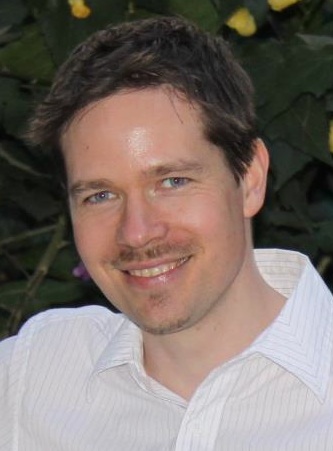
A Human View is curated by Jed Stevenson, teaching fellow in medical anthropology at University College London.

A12-Jed

Jed has conducted anthropological fieldwork in Ethiopia and the Republic of Congo.

He also blogs about his family here.

Unless otherwise indicated, blog posts are distributed under the terms of the Creative Commons Attribution-NonCommercial Licence (CC BY-NC), which permits unrestricted use, distribution, and reproduction in any medium, provided the original work is properly cited.

Posted in books, inspiration | Tagged , | Leave a comment